Geneva: The year 2025 emerged as the deadliest year for journalists since the beginning of the century, after 2024. According to the tally of the Press Emblem Campaign (PEC), 161 media professionals were killed in 31 countries (179 in 2024). At least 60 journalists were killed in the Gaza Strip, almost all of them victims of Israeli strikes. Since the start of hostilities triggered by Hamas on 7 October 2023, at least 221 Palestinian media personnel have been killed in Gaza (81 in 2023, 80 in 2024, 60 in 2025). The war between Ukraine and Russia has resulted in the deaths of nine journalists, who were killed by either Ukrainian or Russian fire. Three Ukrainian journalists were killed, as was French journalist Antoni Lallican in Ukraine, and five Russian journalists were killed by Ukrainian fire in the border regions (in Ukraine and Russia).
“The increasing use of undetectable, ultra-fast drones poses a new and serious threat to war reporters on both sides. Access to victims is even more restricted,” lamented Blaise Lempen, president of PEC (https://www.pressemblem.ch/). By region, the Middle East leads with 87 deaths, ahead of Latin America with 25, Asia with 22, Africa with 15, Europe with 10 and the United States with 2. Two-thirds of the victims recorded in 2025 were killed in an area of armed conflict (108). Among the countries most affected, the PEC deplores the deaths of 15 media workers in Yemen, including 13 in an Israeli attack on 10 September. Faced with violence from drug traffickers, Mexico remains a country with the highest number of journo-victims, with nine murders in 2025. The situation in Sudan has also worsened due to ongoing fighting, with at least eight deaths among Sudanese media personnel.
The PEC counted six victims in India, five in Ecuador and five in Pakistan. Four were killed in Bangladesh, four in Iran, targeted by an Israeli attack in Tehran, and four in the Philippines. In Peru, three journalists were murdered. There were also three victims in Syria. Next came Afghanistan, Colombia, Honduras, Iraq, Lebanon, Nigeria, the Democratic Republic of Congo (DRC) and the United States, with 2 killed in each country. One death was recorded in each of the following countries: Brazil, Guatemala, Haiti, Nepal, Saudi Arabia, Somalia, Tanzania, Turkey and Zimbabwe.
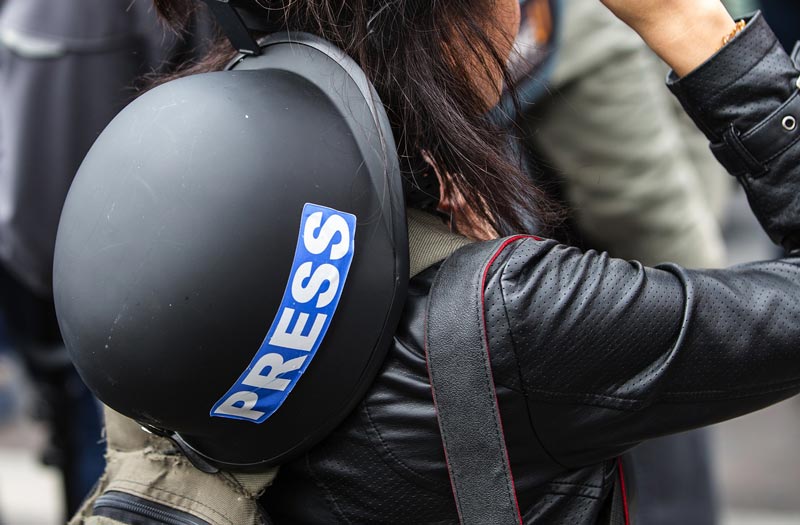
Among the PEC’s main concerns, impunity remains a major problem. In the absence of independent investigations and prosecutions, these crimes are on the rise. The PEC supports the recommendation issued by the conference on the protection of journalists in armed conflicts, which met in Doha of Qatar, on 8 and 9 October, calling for the creation of an international commission of inquiry under the auspices of the UN pending the adoption of an international convention on the protection of journalists in conflict zones with the creation of an internationally recognised press emblem. The PEC is also very concerned about the increase in the number of individual requests for support it has received from persecuted journalists seeking safe asylum. Journalists from Afghanistan, Cameroon, Syria, Turkey and Sudan have requested assistance from the PEC.
“Unfortunately, democratic governments are increasingly closed to such requests and persecuted journalists face almost systematic rejection of their asylum application. This is distressing,” said the PEC chief, clarifying that unlike other organisations, the PEC includes all journalists killed in its statistics, regardless of whether their death was related to their professional activity. It is difficult to prove that a crime was committed in connection with a journalist’s work without a thorough and independent investigation, which is often lacking.
PEC’s south and southeast Asia representative Nava Thakuria informed that India lost six media professionals to assailants this year, compared to four in 2024, including Mukesh Chandrakar (stringer to NDTV from Bastar, Chhattisgarh), Raghavendra Vajpayee (Dainik Jagaran from Imalia Sultanpur, Uttar Pradesh), Sahadev Dey (Republic Andaman, from Diglipur, Andaman islands), Dharmendra Singh Chauhan (Fast News India, Gurugram, Haryana), Naresh Kumar (Times Odia, Bhubaneswar, Odisha) and Rajeev Pratap Singh (Delhi Uttarakhand Live, Joshiyara, Uttarakhand) till date. On the other hand, Pakistan that witnessed murder of 12 media persons last year, recorded the killing of AD Shar (Hum News, Khairpur, Sindh), Abdul Latif (Daily Intekhab/Aaj News, Awaran, Balochistan), Syed Mohammed Shah (Ab-Tak TV, Jacobabad, Sindh), Imtiaz Mir (Metro One News, Karachi, Sindh) and Tufail Rind (Royal News, Ghotki, Sindh) this year.
Bangladesh, which reported the murder of seven media workers last year, recorded the killing of Assaduzzaman Tuhin (Dainik Pratidiner Kagoj, Gazipur), Bibhuranjan Sarkar (Ajker Patrika, Munshiganj), Wahed-uz-Zaman Bulu (Dainik Ajker Kagoj, Dhaka) and Khandahar Shah Alam (Dainik Matrijagat, Dhaka) in 2025. Philippines with only one casualty last year also lost four journalists namely Juan Johny Dayang (Philippine Graphic Magazine, Aklan), Erwin Labitad Segovia (Radio WOW FM, Bislig City), Noel Bellen Samar (DWTZ, Guinabatan) and Gerry Campos (Barangay Sta. Cruz, Surigao del Sur) this year. Afghanistan lost two scribes namely Abdul Ghafoor Abid (Paktia National Radio Television, Khost) and Abdul Zahir Safi (State run media outlet, Kabul) this year, even though it had no journo-casualty in 2024. Nepal, which recorded one journo-murder last year, repeated with the killing of Suresh Rajak (Avenues TV, Kathmandu) in 2025. Myanmar, which lost three scribes last year, Cambodia (lost 1) and Indonesia (1) evaded any media casualty this time.