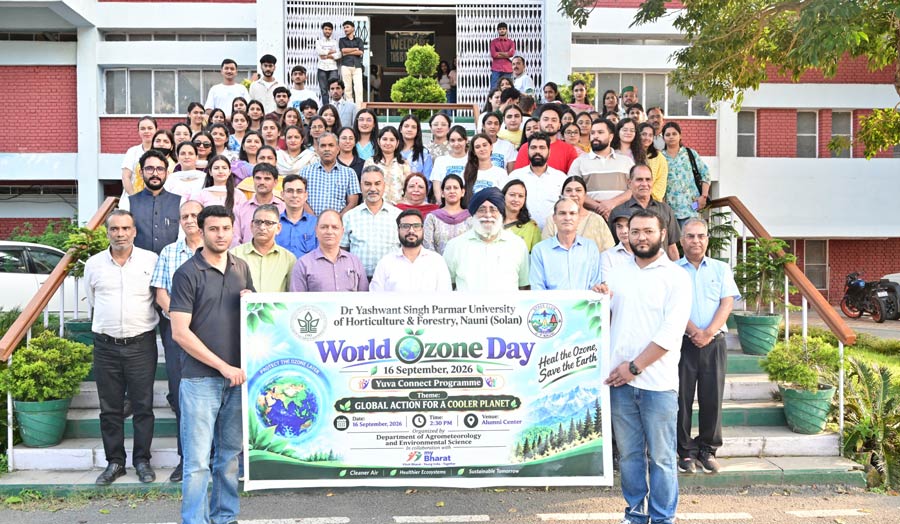
The theme “Global Action for cooler Planet 2026” is a fitting call for this year’s World Ozone Day, yet it demands firm commitments and consistent efforts from every stakeholder to yield meaningful results.
Historically, the over-exploitation of natural resources by developed nations has led to an ecological debt that continues to fuel debates on ozone depletion and climate change. Pointing fingers for the failure to control greenhouse gas (GHG) emissions is no longer a viable solution. The ever-expanding ozone hole exposes life on Earth to dangerous ultraviolet (UV) radiation, disrupts ecosystems, damages economic activities, and risks large-scale catastrophes. Scientists globally feel a moral responsibility to develop sustainable strategies and comprehensive methods to mitigate and adapt to these changes, with a special focus on protecting vulnerable groups, flora, fauna, biodiversity, and the entire terrestrial and aquatic ecosystems.
Today, unprecedented shifts in climate and weather patterns are observed compared to the pre-industrial era. Manifestations such as acidification, increased salinity, desertification, forest fires, declining agricultural productivity, threats to human health, glacier melting, rising sea levels, torrential rains, landslides, soil erosion, and mass species migrations are clear signs of this crisis. These phenomena contribute to ozone depletion, global warming, resource limitations, malnutrition, reduced hydrological processes, and drinking water scarcity.
International Actions ought to be focussed mainly on the following aspect to protect Ozone depletion:-
- Full implementation of the Montreal Protocol.
- Accelerated phase-out of remaining ODS.
- Implementation of the Kigali Amendment for HFC phase-down.
- Recovery and safe destruction of ODS from old equipment.
- Prevention of illegal ODS production and trafficking.
- Promotion of low-GWP, energy-efficient cooling technologies.
- Technology transfer and capacity building for developing countries.
- Strengthening atmospheric monitoring and early-warning systems.
- Integrating ozone protection with climate and sustainable-development policies.
- Public awareness and behavioural change, particularly regarding refrigeration, air-conditioning and UV protection.
According to the UNFCCC, “Climate change refers to a change in the climate directly or indirectly attributed to human activity that alters the atmospheric composition in addition to natural variability observed over a comparable time period.”
Since the pre-industrial era, concentrations of key GHGs have surged:
Carbon dioxide (CO₂): from 278 ppm to 390.5 ppm (~40% increase).
Methane (CH₄): from 722 ppb to 1803 ppb (~150% increase), with 22 times more warming potential than CO₂.
Nitrous oxide (N₂O): from 271 ppm to 324.2 ppm (~20% increase).
Fluorinated gases—CFCs, HFCs, perfluorocarbons, and sulfur hexafluoride—are potent GHGs from industrial processes and have exceptionally high Global Warming Potentials (GWPs). For instance, sulfur hexafluoride’s GWP is 3200 times that of CO₂, increasing to 17,500 over 20 years, and 23,500 after 100 years in the atmosphere.
The Intergovernmental Panel on Climate Change (IPCC) reported in 2018 that human activities have already contributed to approximately 1°C of global warming above pre-industrial levels, with a likely range of 0.8°C to 1.2°C.
In 1985, scientists identified a massive ozone hole over Antarctica measuring 24.5 million km², mainly due to the release of CFCs in air conditioners, refrigerators, and fumigants. UV rays break down CFCs, releasing chlorine atoms, which catalytically destroy ozone molecules, enabling one chlorine atom to damage over 100,000 ozone molecules in a chain reaction.
Ozone, predominantly found in the stratosphere (20–50 km above Earth’s surface), forms a protective layer that filters harmful UV-B rays. The consequences of ozone depletion are profound:
Human health risks: DNA damage, cataracts, skin cancers, immune suppression.
Agricultural impact: Impaired plant growth and crop yields.
Marine ecosystem disruption: Phytoplankton productivity decreases by 5% for every 16% ozone loss, reducing fish production by 7 million tons annually.
Coral reef decline: Loss of symbiotic zooxanthellae due to temperature rise and acidification weakens the habitat for over 40% of marine microorganisms.
The solution does not rest solely in technology or policy but requires a cultural shift toward responsible consumption, innovative policymaking, and enhanced public awareness. As Mahatma Gandhi wisely noted, “The Earth provides enough to satisfy every man’s need, but not every man’s greed.” The time to act is now.
Milestones in global environmental governance include:
Vienna Convention (1987): Phased reduction of ODS (Ozone Depleting Substances).
Earth Summit (1992, Rio de Janeiro): Laid the foundation for sustainable development with Agenda 21.
UNFCCC (1992): Framework signed by 192 nations to stabilize greenhouse gases.
Kyoto Protocol (1997): Industrialized countries pledged a 5.2% GHG reduction from 1990 levels by 2012, introducing carbon credits for developing nations.
Paris Agreement (2015): A landmark accord with 175 nations committing to sustainable development and emission reduction targets.
India’s role includes:
Hosting COP-14 in 2019 and pledging restoration of 26 million hectares of degraded land by 2030.
Committing to 33–35% reduction in energy intensity by 2030 (from 2005 levels).
Creating an additional carbon sink of 2.5–3 billion tons CO₂ through afforestation.
Alarmingly, 12 million hectares of land are lost globally each year, contributing to declining agricultural output and rising food insecurity. Moreover, 75% of emerging infectious diseases are zoonotic, transferring from animals to humans—a fact exemplified by the COVID-19 pandemic. In the words of Inger Andersen (UNEP), “COVID-19 is a message to humanity.”
National strategies like the National Action Plan on Climate Change (2008) and corresponding State Action Plans address mitigation and adaptation measures, yet emissions continue unabated. According to UN data (2015), 74% of the world’s poorest are directly affected by land degradation.
Effective strategies, people’s active participation, and strong commitments will be critical to ensure food, livelihood, and health security.
Each one of us being an integral part of this universe as an Individual can take up suitable , viable common measures in Protecting the Ozone Layer, for example :-
- Choose ozone-friendly products
Prefer refrigerators, air-conditioners, foams and other products that use ozone-safe refrigerants and have low global-warming potential. - Maintain ACs and refrigerators properly
Prevent refrigerant leakage through regular servicing and maintenance. - Never release refrigerants into the atmosphere.
2.Dispose of old equipment responsibly
Do not simply sell or discard old cooling equipment as scrap.
3.Avoid products containing controlled ODS
Check labels and choose products certified as ozone-friendly where relevant.
4.Use air-conditioning efficiently
Set reasonable temperatures, maintain filters and improve natural ventilation where possible.
5.Support responsible businesses
Choose service providers who use approved refrigerants and proper recovery systems. - Reduce unnecessary consumption
6.Spread awareness
Educate family, schools, communities and colleagues about the ozone layer and the importance of responsible refrigeration and waste The individual may not control the ozone layer, but every individual can control what enters the atmosphere through the products we buy, use, maintain and discard.
Broadly it can ne concluded that climate change does not discriminate, but its impact is worst felt by the marginalized, especially women who face heightened vulnerability. A sustainable path forward involves integrated solid waste management, green technology, climate-resilient infrastructure, and shifting lifestyle choices. Our cooler planet’s future depends on what we do today.
The author: Dr GR Sahibi
Retd from Indian Forest Service.
He is PhD (environment and ecology , post graduate certificate climate Change, MBA
And now senior Vice President Saarthi Welfare Society Solan